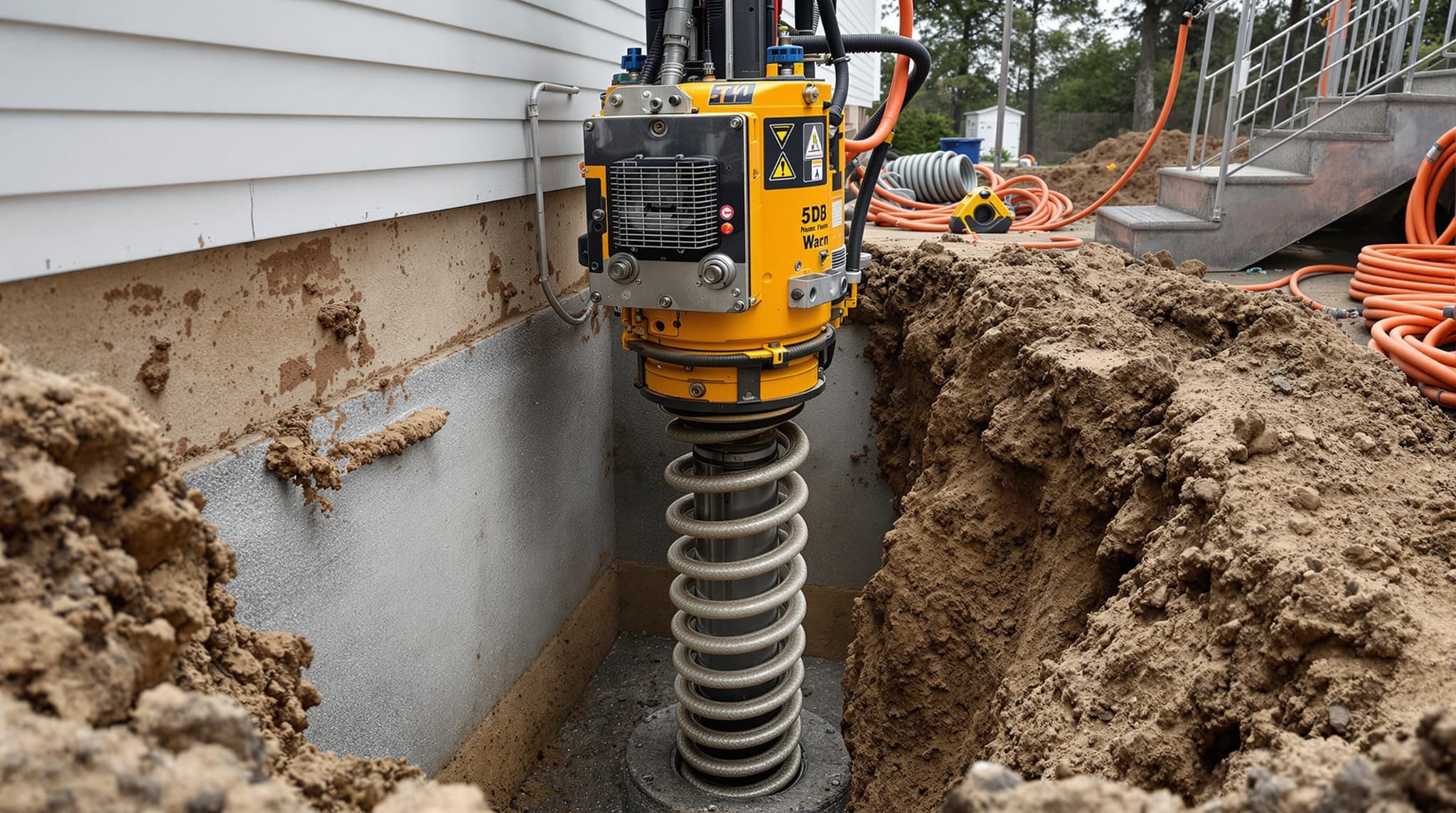
What Are Helical Piers and How Do They Work
A helical pier is a steel pipe with helical steel plates welded around it at calculated intervals — it looks, roughly, like an oversized screw. Installation uses a hydraulic torque motor (driven by a skid-steer or walk-behind machine depending on access) that rotates the pier into the ground until the helical plates reach soil or rock with sufficient bearing capacity to support the applied load.
Once the pier is at depth, a steel bracket is attached to the bottom of the foundation footing. The structure's load is then transferred through the bracket and down the pier shaft to the competent bearing layer below — bypassing the weak, compressible, or saturated soil that was allowing the foundation to sink.
In most residential applications on Long Island, the piers are also used to lift the affected foundation section back toward its original elevation. Hydraulic rams on each pier work simultaneously, raising the structure incrementally and monitoring for stress at adjacent elements. A PE on staff supervises the lift and determines the target elevation — returning a settled foundation to its original position is the goal, not just arresting further movement.
Helical piers stabilize and lift. They do not fill voids, inject grout, or address water infiltration. If water is the cause of the settlement, waterproofing must be addressed separately — piers alone will not prevent continued degradation of the bearing soil.
When Foundation Piers Are the Right Repair
Piers are the appropriate repair when the problem is vertical settlement — a foundation element that has moved downward because the soil beneath it can no longer support the load. Specific indicators:
- →Stair-step cracks in brick or block coursing
- →Doors and windows that bind or won't close squarely
- →Floor slopes measurably toward one wall
- →Section of foundation visibly lower than adjacent sections
- →A crack that has widened progressively over multiple years
- →Chimney or addition settling away from the main structure
- →Soil erosion or washout visible under or near the footing
- ✕Lateral wall movement (bowing or leaning) — use carbon fiber or anchors
- ✕Shrinkage cracks that haven't moved in years
- ✕Horizontal cracks in block walls — different failure mode
- ✕Cosmetic hairline cracks without structural displacement
- ✕Water infiltration without settlement component
A structural assessment distinguishes active settlement from dormant cracking — cracks that occurred historically and are no longer moving. Do not assume helical piers are required based on the presence of cracks alone. Our foundation settlement repair assessment includes a crack measurement record, floor elevation survey with a digital level, and a determination of whether the movement is active or historical.
Why Long Island's Soil Makes Pier Depth Unpredictable
Long Island's geology is the result of two glacial depositional events — the Ronkonkoma Moraine (running through central Nassau and mid-Suffolk) and the Harbor Hill Moraine (the north shore). Between and south of these ridges are glacial outwash plains: layers of sand and gravel deposited by meltwater, with variable depth to clay till underneath.
For pier installation, this means bearing depth varies dramatically across short distances. A house in Hicksville (Nassau moraine zone) might hit dense gravel at 18 feet. A house half a mile away in an outwash depression might need piers to 30 feet or deeper before reaching adequate bearing capacity. On the South Shore — Merrick, Massapequa, Bellmore, Wantagh — high water tables and deep sand layers mean piers frequently go to 35 to 45 feet before reaching the clay hardpan layer.
This is why cost estimates that don't reference a soil boring or on-site torque testing are inherently unreliable. The helical pier installation process is self-verifying — torque is monitored during installation, and piers are driven until they achieve the PE-specified installation torque, regardless of depth. But depth drives cost: a pier at 40 feet uses more material and more installation time than one at 18 feet.
Depth ranges are typical, not guaranteed. Actual depth is determined by torque monitoring during installation per PE-signed design.
Helical Piers vs. Push Piers: Which One for Your House
Both systems achieve the same goal — transferring foundation load past weak soil to a competent bearing layer — but they install differently and suit different site conditions. On Long Island residential work, we use both depending on the situation.
For most interior foundation repair scenarios on Long Island — a corner of the house that has settled, a section of wall with active stair-step cracking, or a basement corner that has dropped — helical piers are the more practical choice. For perimeter wall stabilization on a heavier structure with exterior access, push piers may be specified. Our pier systems service page covers both options with more technical detail.
Helical Pier Cost on Long Island
Cost is driven primarily by pier count and depth. Secondary factors are footing access (exterior vs. interior installation), whether a floor slab needs to be cut, and whether the affected area requires PE-supervised lifting vs. stabilization only.
All pricing includes PE assessment, permit filing, installation, bracket attachment, and floor/landscape restoration. Fixed-price written quote provided after on-site assessment.
Nassau and Suffolk County building permits are required for structural pier installation and are included in our quoted price. PE-stamped engineering drawings are required for the permit application — these are prepared by our staff PE and included in the project cost.
Frequently Asked Questions
How much does helical pier installation cost on Long Island?
Helical pier installation on Long Island typically runs $1,200 to $2,500 per pier installed, with most residential foundation stabilization projects requiring 6 to 16 piers depending on the affected wall length and load. Total project cost ranges from $8,000 to $30,000 for most Nassau and Suffolk County homes. The wide range reflects pier depth (Long Island's variable geology means some piers hit competent bearing capacity at 15 feet, others at 35 feet or deeper), accessibility (interior vs. exterior installation), the number of active differential settlement zones, and whether excavation is required to access the footing. We provide a fixed-price written quote after the on-site structural assessment — the assessment is free.
What is the difference between helical piers and push piers?
Both systems transfer foundation load down through weak soil to competent bearing strata, but they install differently and suit different conditions. Helical piers are screwed into the ground using a hydraulic torque motor — they look like large steel screws with helical plates. They can be installed before the structure is loaded (proactive stabilization) and in soils with limited overhead clearance or tight basement access. Push piers are hydraulically driven straight down using the weight of the structure itself as resistance, which means the house has to be heavy enough to resist the driving force. On Long Island, helical piers are often preferred for interior applications and lighter residential structures because they don't require the structure's weight to achieve installation depth. Push piers are common for heavier commercial applications and perimeter wall stabilization where exterior access is available.
How do I know if my foundation needs piers or something else?
Foundation piers are the right repair when a foundation element has moved — settled, sunk, or shifted — and the underlying cause is soil that cannot support the load. Signs include: stair-step cracks in brick or block, doors and windows that no longer square, floors that slope measurably toward a wall, a section of the foundation that is visibly lower than adjacent sections, or a crack that has widened progressively over time. Piers are not the right fix for lateral movement (a bowing or leaning wall) — those require carbon fiber or wall anchors. They are also not needed for cosmetic cracks that haven't moved in years. A structural assessment distinguishes between active settlement and dormant cracking — do not assume piers are needed just because cracks are present.
How deep do helical piers go on Long Island?
Pier depth on Long Island varies significantly by location, which is one reason why cost estimates without a soil assessment are unreliable. Nassau County's north shore and the north fork of Suffolk sit on glacial moraine — dense, irregular gravel and clay deposits that often provide good bearing capacity at 15 to 25 feet. The south shore and south fork have shallower outwash sand over deeper clay layers; bearing depth there can range from 20 to 40 feet depending on the specific site. Helical piers are torqued to a specified installation torque that correlates to bearing capacity — depth is a result, not a target. We track torque during installation and stop when the specified capacity is achieved, verified by the PE-signed design.
Does helical pier installation damage my foundation or landscaping?
Minimal. Interior helical pier installation requires a core drill through the concrete floor slab at each pier location (typically a 6-to-8-inch hole), excavation to expose the footing (usually 2 to 3 feet of soil removal), bracket attachment, and pier installation. The floor core is patched with hydraulic cement after installation. Landscaping impact is site-dependent: interior installations have no exterior disturbance at all. Exterior installations require 2-to-3-foot-wide access corridors along the affected foundation wall — shrubs and small trees may need to be temporarily removed and are replanted after. Fences, patios, and hardscape within 3 feet of the foundation may need to be cut for access.
Think Your Foundation Has Settled?
Our pier systems team has installed over 2,100 repairs in Nassau and Suffolk County. Free on-site structural assessment — we measure, photograph, and give you a written determination of whether piers are needed and at what scope before you commit to anything. See our settlement repair service for more detail, or call now.