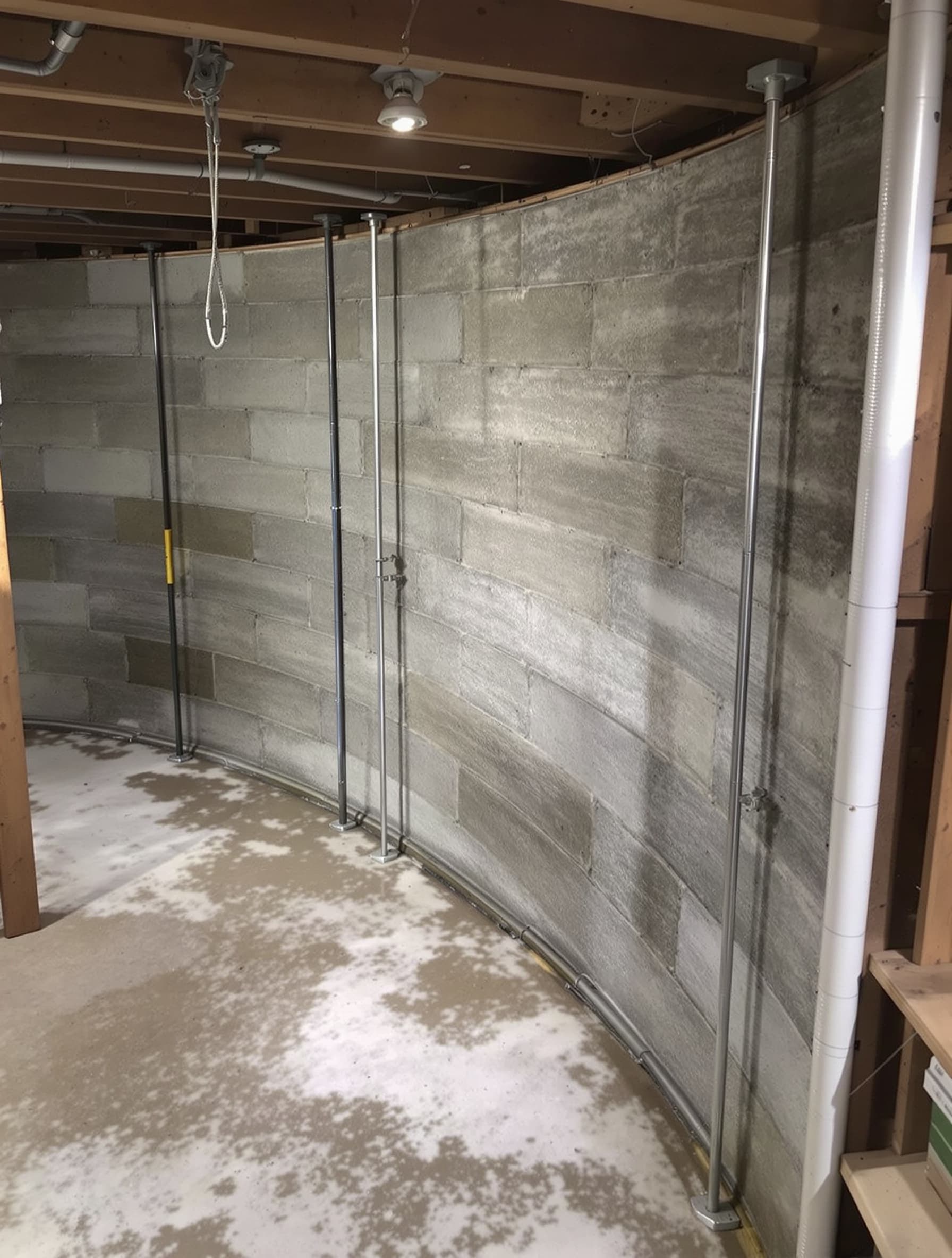
Leaning basement wall repair on Long Island is one of the most urgent foundation problems a homeowner can face. Unlike a settled vertical crack that develops slowly over years, a leaning or bowing wall is under active load — lateral soil pressure is pushing in against the wall face right now, and every freeze-thaw cycle and rain event adds cumulative movement. Long Island homeowners deal with this more than most: the island's post-war housing stock, built largely between 1945 and 1975, relied on unreinforced concrete block foundations that were not designed for the soil pressures they've been absorbing for 50-plus years.
This guide covers what a leaning basement wall actually looks like, why Long Island's specific soil conditions make the problem worse than the national average, how the repair works, what it costs in Nassau and Suffolk County, and when to stop monitoring and call today.
Signs Your Long Island Basement Wall Is Leaning
Most leaning walls announce themselves gradually over years before any single event makes them obvious. Knowing what to look for — and how to confirm what you are seeing — can mean the difference between a carbon fiber repair and an emergency wall reconstruction.
Horizontal Cracks at Mid-Wall Height
The most reliable early indicator is a horizontal crack running across the block courses at roughly mid-wall height. This is where bending stress concentrates when lateral soil pressure pushes against the upper portion of the wall: the wall bends at its midpoint like a beam under load. Horizontal cracks in block foundations are not cosmetic. They mean the wall has already started to yield under lateral force. If you see one, measure its length, mark the ends with a pencil and the date, and check back in 30 days. If the crack has grown, you are dealing with an active, progressing failure.
Visible Inward Curve When Sighting Down the Wall
Stand at the corner of the basement wall and look down its length. A wall that is leaning or bowing will show a visible curve inward at center. This is one of the quickest confirmations available without equipment. You can also hold a straight-edge or a 4-foot level vertically against the wall face: any gap at the center of the level indicates inward deflection. Gaps larger than 1/2 inch are significant; gaps over 2 inches put the wall in the high-risk repair category.
Sticking Basement Windows and Doors
As a basement wall leans inward, the frame of the structure above it shifts. Window frames in or above the affected wall section begin to rack — the rectangular frame distorts into a parallelogram and windows no longer open or close cleanly. Basement door frames show the same symptom. This is a structural signal, not a settling or humidity issue: the frame is racking because the wall below it is moving.
Gaps at the Sill Plate
Where the first-floor framing sits on top of the foundation wall, look for gaps or separations between the sill plate and the top of the block. A leaning wall pulling away from the floor framing above will create a visible gap there. This is a late-stage sign — if you are seeing sill plate separation, the wall has been moving for a while and the repair scope is likely more extensive.
White Mineral Deposits Along a Horizontal Crack
Efflorescence — the white powdery mineral residue left when water evaporates — concentrated along a horizontal crack line indicates that water has been moving through that crack repeatedly. This means the crack is wide enough for water infiltration and has been open for at least one wet season. It is a confirmation, not a primary indicator, but it tells you the crack is active rather than old and sealed.
Nassau vs. Suffolk County Soil Factors Causing Wall Lean
Long Island's geology is a direct result of the last glacial retreat, and that geology creates two distinct soil environments with different wall-lean failure modes. Understanding which county you are in matters for repair design — the same two inches of deflection may require different anchor depths and spacing in Nassau vs. the Suffolk north shore.
Nassau County: Clay-Heavy Glacial Till
Nassau County sits largely on glacial till — a dense, unsorted mix of clay, silt, sand, and gravel deposited directly by the glacier. The clay fraction in this soil is the problem for basement walls. Clay expands when it absorbs water and shrinks when it dries. In a typical Nassau County wet season, saturated clay against the foundation wall exerts lateral pressure measured in hundreds of pounds per square foot — well beyond what an unreinforced block wall was designed to resist indefinitely. La Nina years with prolonged wet winters, like 2022 and 2023, spike wall-lean calls in Nassau as the soil stays saturated far longer than in average years.
Nassau County towns with the highest concentration of leaning basement wall jobs: Levittown, Massapequa, Hicksville, Uniondale, and Westbury — all densely built with 1950s block foundations in areas where the till is clay-dominant.
Clay soil lateral pressure in wet years: 200–400 psf against the wall face. Block walls in Nassau County post-war homes were typically designed for 100–150 psf. Most Nassau leaning walls are on the north-facing or uphill wall where drainage is worst.
Suffolk County North Shore: Glacial Moraine and Clay
The Suffolk County north shore — Huntington, Northport, Cold Spring Harbor, Smithtown, and Kings Park — sits on the Harbor Hill moraine, a ridge of glacially deposited clay-heavy soils left by the retreating ice sheet. These soils are geologically similar to Nassau's glacial till but often steeper in grade, meaning surface runoff concentrates against the uphill foundation wall. This is the highest-concentration zone for leaning basement walls in all of Suffolk County. Homeowners on north-shore slopes in Huntington and Smithtown regularly see horizontal cracks and inward deflection on their uphill walls.
Suffolk County South Shore: Sandy Outwash and Hydrostatic Pressure
The south shore of Suffolk — Babylon, Bay Shore, Lindenhurst, and coastal areas — sits on outwash plains of sandy, well-draining soils. Sandy soils do not exert the same expansive clay pressure as the north shore, but the water table in many south shore areas sits within 4–8 feet of grade. When the water table rises after storms, hydrostatic pressure against the foundation wall can be as high as saturated clay pressure — it just acts differently. South shore leaning walls often show more uniform inward bow across the entire wall face rather than the mid-height horizontal crack pattern common in clay-soil areas. The repair process is the same; the soil boring depth and anchor spacing may differ.
Repair Methods for Leaning Basement Walls
Carbon Fiber Straps: The Standard Repair for Most Long Island Homes
For leaning or bowing basement walls with under two inches of inward deflection, carbon fiber strap installation is the standard of care. Structural-grade carbon fiber fabric is saturated with two-part epoxy and bonded vertically to the wall surface, floor-to-ceiling, at four-foot centers. Once cured, the strap is structurally continuous with the concrete block and resists further inward movement. The material is ten times stronger than steel by weight. No excavation is required — the work is done entirely from inside the basement. Most installations complete in one day. The material carries a lifetime warranty.
Carbon fiber straps are the right choice when the wall is not actively moving past the two-inch threshold and soil conditions are stable enough that no future tightening will be needed. They are irreversible once installed — they cannot be tightened after the fact — so accurate deflection measurement before installation is critical.
$2,000 – $8,000 per wall
Based on wall length, deflection severity, and strap count. $650–$1,100 per strap installed.
Wall Anchors: For Severe Deflection or Active Movement
When inward deflection has exceeded two inches, or when the wall is still actively moving, steel wall-anchor systems are the engineered solution. Wall anchors consist of steel plates bolted to the interior wall face, connected by a steel rod threaded through the foundation to a buried steel plate in the yard. Once installed, the system can be retightened over time as the soil settles — a capability carbon fiber does not offer. This ability to gradually tension the anchor back toward plumb makes wall anchors appropriate when soil conditions may continue producing movement after the initial installation.
Installation requires excavation for the exterior plates — typically a 12-to-18-inch diameter hole at each anchor location, not a full trench. Most basement wall repair projects using wall anchors complete in two to three days. Nassau and Suffolk County building permits are required and include PE-stamped engineering drawings.
$8,000 – $20,000 per wall
Includes anchor installation, exterior plates, excavation, and yard restoration. Exact cost after deflection survey and PE assessment.
When to Call Immediately vs. Monitor
- !Deflection over 2 inches at mid-wall
- !Horizontal crack that is visibly growing
- !Wall actively moving between visits
- !Floor system above affected — doors racking, floors bouncing
- !Gap forming at the sill plate
- !Water actively entering through a horizontal crack
- !Any crack accompanied by a visible lean from the corner
- →Horizontal crack under 1/8 inch, ends marked, no growth in 90 days
- →Slight inward bow under 1/2 inch with no recent change
- →Old horizontal crack that has been stable for years
- →Inspector noted it but rated it minor on original report
When in doubt, send a photo to a licensed foundation contractor before deciding to monitor. A photo assessment is free and takes minutes. The risk of under-responding to a leaning wall is significantly worse than over-responding to a stable one.
Basement Wall Repair + Carbon Fiber Reinforcement
Our basement wall repair service covers the full diagnosis and repair process for leaning and bowing walls across Nassau and Suffolk County, including pricing and what to expect on the day of repair. For carbon fiber specifically, our carbon fiber wall reinforcement page covers strap count, epoxy process, and what a properly installed system looks like. If water is also present, our foundation waterproofing service addresses the moisture side of a combined wall-lean-plus-water problem.
See Full Basement Wall Repair Details